
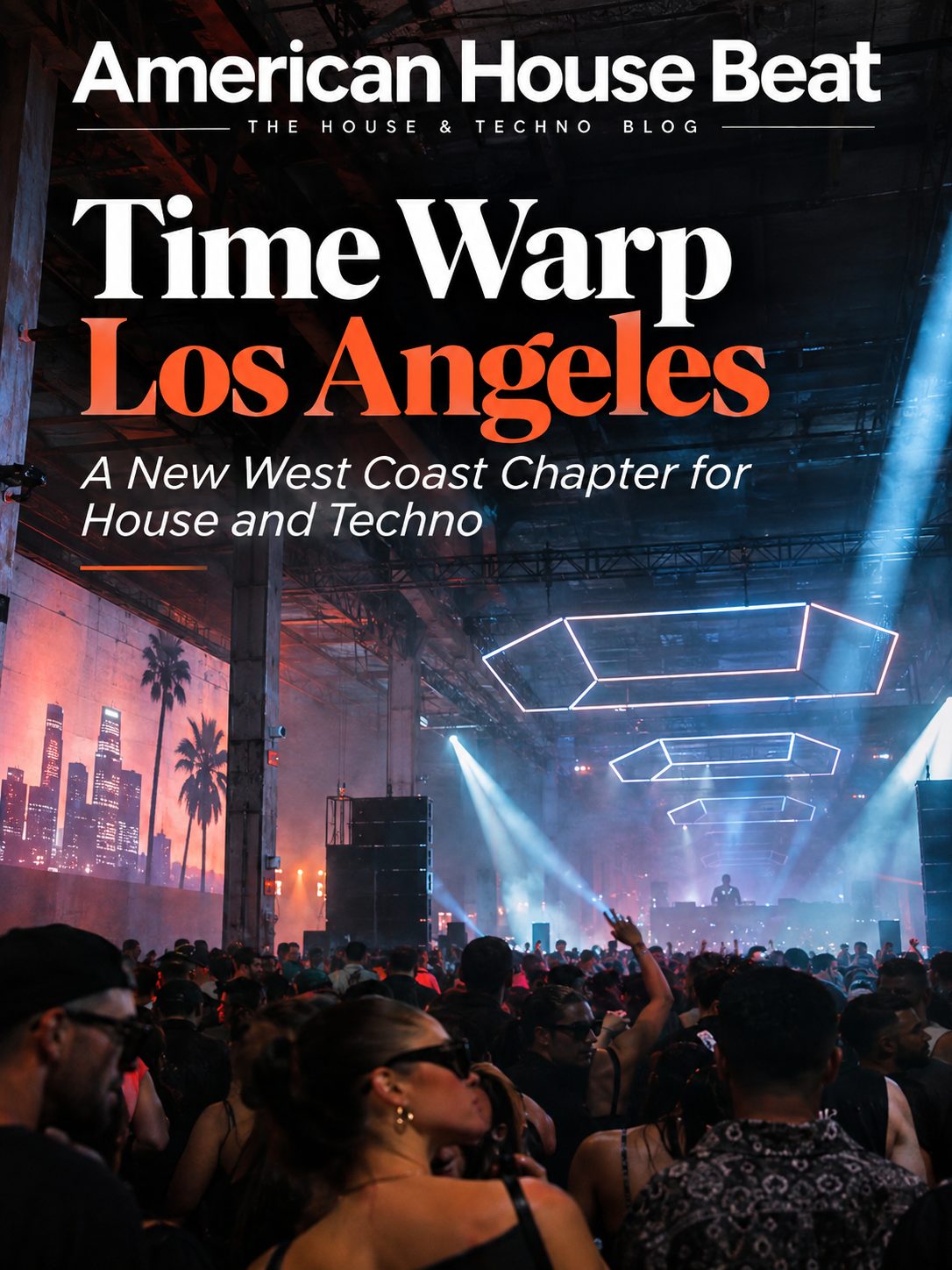
One of Europe’s most established Techno institutions is heading to the American West Coast for the first time.
On November 27 and 28, Time Warp will make its Los Angeles debut at ACE*Mission, transforming previously unused warehouse spaces into a two-day House and Techno festival.
The organisers have now confirmed the full day-by-day programme, making the musical identity of each date much clearer.
Friday moves across House, groove and experimental club music.
Saturday shifts decisively toward Techno.
For the American electronic landscape, the distinction is important.
Los Angeles is not simply getting another European festival import.
It is getting two different interpretations of contemporary club culture inside the same industrial complex. (time-warp.de)
Time Warp finally reaches the West Coast
Time Warp began in Germany more than three decades ago and became internationally recognised for long-form Techno programming, large-scale production and an obsessive focus on sound.
The brand later expanded into cities including New York, Buenos Aires and São Paulo.
Los Angeles is the latest chapter.
The debut takes place inside ACE*Mission, where Time Warp will activate warehouse areas that organisers say have never previously been used as event spaces. (press.insomniac.com)
That matters because warehouse culture has become central to the identity of electronic music in Los Angeles.
The city already supports a dense ecosystem of underground promoters and temporary industrial locations.
Time Warp arrives with a much larger production infrastructure but uses the same architectural language.
Concrete.
Steel.
Open industrial volume.
Sound.
Friday starts with House
The Friday, November 27 programme leans toward House and more groove-oriented forms of electronic music.
The lineup includes:
Ahmed Spins
Cloudy
Colored Craig
DESIREE
fun2bjane
Funk Tribu
Gerd Janson b2b Julya Karma
HAAi
Helena Hauff b2b Juliana Huxtable
INVT
Loco Dice
The Martinez Brothers
ØTTA
ONYVAA
Quest b2b Ryan Elliott
Tiga
The names create several different routes through contemporary dance music.
Loco Dice and The Martinez Brothers bring strong House and club roots.
Ahmed Spins and DESIREE represent a newer global House audience.
Gerd Janson connects Disco, House and European selector culture.
INVT brings a Miami-born Latin electronic identity.
Then there are artists such as Helena Hauff and Juliana Huxtable, whose back-to-back can push the room much further into Electro, Techno and more unpredictable territory.
Friday therefore does not behave like a simple House stage.
It is broader.
Saturday belongs to Techno
The tone changes significantly on Saturday, November 28.
The lineup includes:
Ben Klock
Blawan b2b Elli Acula
Chlär
D.Dan b2b Freddy K
Dennis Ferrer b2b Skream
East End Dubs
Heidi Lawden b2b Masha Mar
John Bryars
Luuk van Dijk
Novah
ØNYX
Richie Hawtin
Rødhåd
SOSA
southstar
SPFDJ b2b TOCCORORO
The centre of gravity moves toward Techno.
Richie Hawtin.
Ben Klock.
Rødhåd.
Chlär.
D.Dan.
Freddy K.
SPFDJ.
These names represent several generations of the genre.
Minimal.
Berlin Techno.
Hard groove.
Faster contemporary club music.
Saturday effectively becomes a snapshot of how broad Techno has become.
Richie Hawtin brings another Detroit connection
Richie Hawtin’s presence is particularly relevant in an American context.
Although born in the UK and raised in Canada, Hawtin developed artistically through the Detroit Techno ecosystem.
His career has always existed between North America and Europe.
Time Warp Los Angeles continues that movement.
Techno returns to the United States carrying decades of European evolution, but many of its foundations still connect back to Detroit.
That circular movement is part of the genre’s history.
America created the language.
Europe transformed its infrastructure.
Now the sound returns through international festival brands.
Ben Klock and Rødhåd bring Berlin
Ben Klock and Rødhåd represent another major branch of that story.
Both are closely connected with Berlin’s Techno culture.
Their presence gives Saturday a strong European industrial identity.
But the setting changes everything.
Berlin clubs are built around long nights and permanent spaces.
Los Angeles warehouse culture is more temporary.
The same music behaves differently inside each environment.
That difference is precisely what makes Time Warp’s arrival interesting.
Dennis Ferrer b2b Skream
One of the most surprising bookings is Dennis Ferrer b2b Skream.
On paper, the two artists come from very different histories.
Ferrer is deeply connected to New York House.
Skream emerged from UK Dubstep before becoming increasingly involved in House and Techno.
Putting them together forces those histories into conversation.
That is what a good back-to-back should do.
Not simply place two similar artists beside one another.
Create tension.
The Martinez Brothers return House to an American room
Friday’s appearance by The Martinez Brothers adds a particularly strong US House connection.
Born and raised in New York, the brothers developed internationally through Ibiza and the European club circuit.
Their career is almost the inverse of the usual story.
American artists entered Europe.
They developed global recognition.
Now they return to major American events carrying that international experience.
Time Warp provides a natural environment for that trajectory.
Los Angeles becomes increasingly important
The choice of Los Angeles reflects a broader shift.
For years, New York was Time Warp’s primary US home.
The New York edition returns on November 20 and 21 for its ninth chapter at the Duggal Greenhouse and Agger Building. (time-warp.de)
One week later, the brand crosses the country.
That is a significant expansion.
Los Angeles is no longer simply an occasional stop for European Techno artists.
It has developed into one of the most important electronic markets in the United States.
Warehouse culture.
Festival infrastructure.
International touring.
Local collectives.
All of those systems now coexist.
Two cities, two different formats
The contrast between New York and Los Angeles is also interesting.
Time Warp New York operates as an overnight event, running from 10 PM until 6 AM.
Los Angeles instead runs from 2 PM until 2 AM across both days. (technomusicworld.com)
This creates a very different festival rhythm.
New York follows the traditional warehouse-night model.
Los Angeles moves from afternoon into darkness.
The same brand adapts to two different American nightlife cultures.
Three stages, 24 hours of music
The Los Angeles edition will use three stages, with twelve hours of programming each day.
Across the weekend, that creates 24 hours of music. (press.insomniac.com)
For a brand known historically for marathon club experiences, the format is notable.
The hours are shorter than a classic European Time Warp marathon.
But the event is broader spatially.
Three stages.
Two days.
More than thirty artists.
The model is adapting.
American club culture gets another European institution
The United States currently sits at an interesting point in electronic music.
House and Techno are more commercially visible than they have been in years.
Artists headline arenas.
EDM festivals increasingly create dedicated underground stages.
Warehouse events attract thousands.
At the same time, audiences are also becoming more selective.
They recognise labels.
Promoters.
Club brands.
Time Warp’s Los Angeles debut is a consequence of that maturity.
A European Techno institution now believes the West Coast can support the full brand.
Not one touring stage.
Not a showcase.
Two days.
Three stages.
A complete Time Warp environment.
No spin-off
The organisers have been unusually clear in how they describe the event.
Los Angeles is not being presented as a simplified American version of Time Warp.
The official statement says:
“Los Angeles doesn’t get a spin-off. It gets the core experience.” (time-warp.de)
That sentence summarises the ambition.
The brand is not testing whether Techno works in Los Angeles.
That question has already been answered.
The challenge is whether one of Europe’s most established club institutions can translate its full identity into the West Coast environment.
On November 27 and 28, ACE*Mission becomes the laboratory.
TIME WARP LOS ANGELES 2026
November 27–28
14:00 – 02:00 each day
ACE*Mission
Los Angeles, California
21+
Three stages.
Two days.
House on one side.
Techno on the other.
And a new American chapter for one of electronic music’s longest-running institutions.