
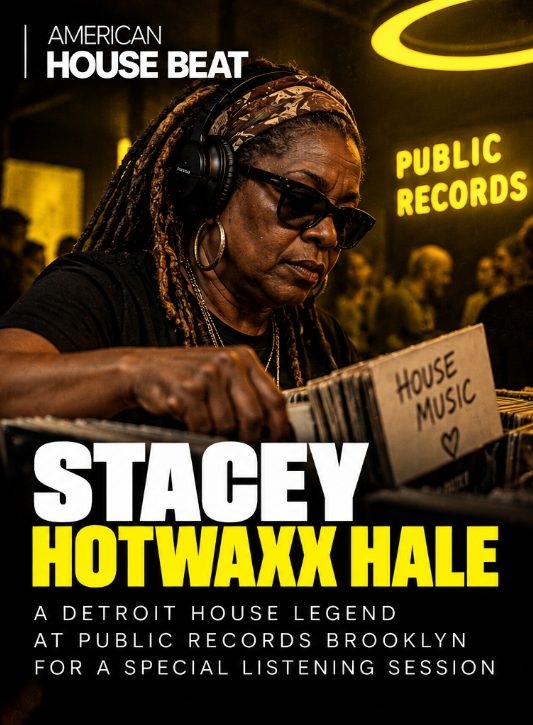
One of Detroit house music’s most important voices is coming to Brooklyn tomorrow night for something very different from a conventional DJ set.
On Wednesday, October 28, Stacey “Hotwaxx” Hale will appear at Public Records for a special live edition of DJ Shannon’s Club Management Podcast, combining conversation, music and a listening session built around Hale’s long career.
The event runs from 19:00 until 22:00 and is designed as an intimate exploration of the records, stories and experiences that shaped one of the longest-running careers in American house music.
For American House Beat, the night is particularly relevant because it places history directly inside contemporary New York club culture.
Not through an exhibition.
Not through an archive.
Through the person who lived it.
The Godmother of House Music
Stacey Hale is widely known as Stacey Hotwaxx Hale, and Resident Advisor describes her as Detroit’s “Godmother of House Music.”
Her career connects several different chapters of American dance culture.
Detroit.
Radio.
Disco.
House.
New York.
Berlin.
The Public Records event will trace that path through conversation with DJ Shannon, including Hale’s early work around influential Detroit radio stations, her experience playing venues such as Studio 54 and her continuing activity on contemporary dancefloors.
That timeline matters because electronic music history is often presented as if scenes existed separately.
Chicago invented house.
Detroit created techno.
New York had disco.
Reality was much more interconnected.
DJs travelled.
Records travelled.
Radio signals crossed cities.
Sounds influenced one another long before online culture made those connections immediate.
Hale’s career sits inside that network.
From Detroit to New York
Detroit remains central to her identity.
Resident Advisor lists the city as the region where she has performed most frequently, alongside New York, Berlin and San Francisco/Oakland.
But New York has its own place in the story.
Hale’s history includes performances at Studio 54, and her more recent appearances have brought her into the city’s current underground circuit.
That creates an interesting bridge.
An artist connected to earlier generations of American dance culture is not being presented only as a historical figure.
She is still part of the contemporary club environment.
That distinction is important.
House history is not finished.
The people who built parts of that culture are still playing, travelling and influencing new audiences.
Listening instead of dancing
The format at Public Records changes the way that history can be experienced.
A DJ set communicates through selection.
A listening session allows the artist to explain the meaning behind that selection.
Why one record mattered.
Where it was first heard.
How one city influenced another.
What changed when technology changed.
What club culture felt like before digital platforms transformed access to music.
Those stories can disappear if history is reduced only to playlists.
The records survive.
The context does not always survive with them.
An event like this puts context back into the music.
Public Records as the setting
Public Records has become one of Brooklyn’s most recognisable spaces for contemporary electronic and listening culture.
Its programme regularly moves between club nights, live performances, talks and listening-focused events.
The Stacey Hotwaxx Hale session fits naturally inside that environment.
It is not designed as a peak-time rave.
It is a slower encounter with club culture.
That may make it even more relevant.
American electronic music is currently experiencing enormous commercial growth.
House and techno now occupy large festival stages, arenas and crossover releases.
At the same time, there is increasing interest in understanding where those sounds came from.
Women inside house history
Hale’s career also challenges another simplified version of dance music history.
The stories of house and techno are often told through a small group of male pioneers.
Women were present throughout those scenes — as DJs, producers, promoters, dancers, radio personalities and organisers — even when their visibility in historical narratives was lower.
Stacey Hotwaxx Hale represents one of those essential perspectives.
Her continued activity makes the point even stronger.
She is not being rediscovered after disappearing from the culture.
She remained inside it.
Detroit house beyond Detroit
This event also demonstrates how Detroit’s influence extends beyond techno.
The city is globally associated with the birth of techno, but its house culture has always been equally important.
Artists, DJs and clubs in Detroit developed their own relationship with house, soul, funk and disco.
Stacey Hotwaxx Hale sits directly inside that tradition.
Her sound is frequently described through swung drums, groove and the emotional side of dance music rather than through one narrow genre definition.
That makes the Public Records session particularly useful for understanding American house as a network rather than a single-city story.
Chicago remains foundational.
New York remains foundational.
Detroit belongs inside that conversation too.
History inside the room
Tomorrow’s event will not recreate the clubs of the past.
It does not need to.
The more interesting opportunity is hearing those histories through the records and memories of someone who moved through them.
That is one of the strongest ways club culture can preserve itself.
Not only through photographs.
Not only through documentaries.
Through conversation between generations.
Club Management LIVE: The Life and Sounds of Stacey “Hotwaxx” Hale
Wednesday, October 28, 2026
19:00 – 22:00
Public Records
233 Butler Street, Brooklyn, New York
Stacey Hotwaxx Hale / DJ Shannon.