
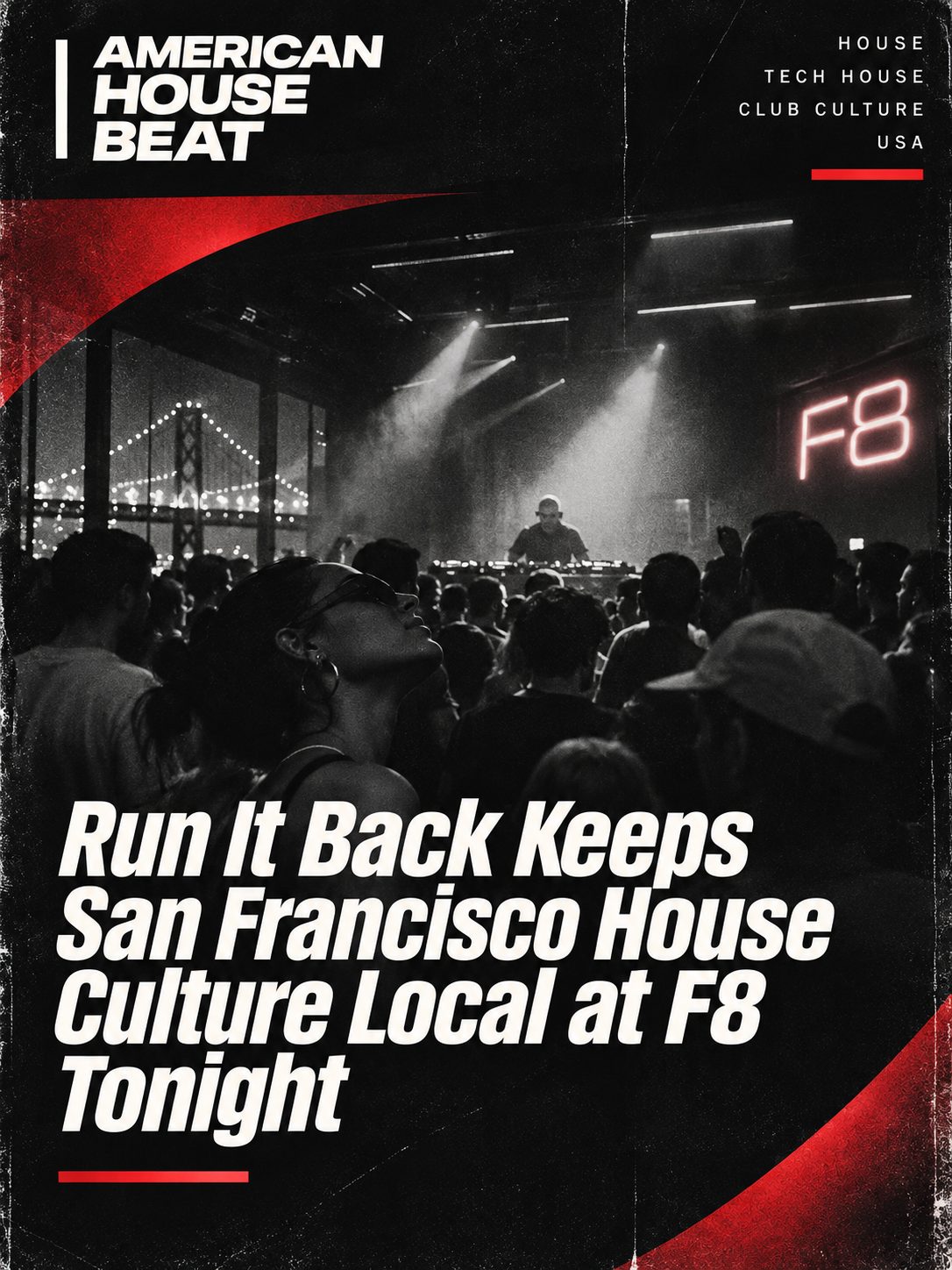
San Francisco does not need an international superstar to create a serious House night.
Tonight, Wednesday, November 11, Run It Back returns to F8 1192 Folsom with two rooms dedicated to House and Tech House and a lineup built heavily around the city’s own electronic community.
The main room features Dual State — the project combining JLittle and Clayton William — alongside DJ Parrot, Watts and Taking Back Sundance, while the second room includes Dymonds, Boubould, Elle Rae and the wider Parrotrix orbit.
The event runs from 21:00 until 02:00.
Entry is free with RSVP before 11 PM, with general admission priced at $10 afterward.
For American House Beat, the most interesting part is precisely what the lineup does not contain.
No giant touring headliner.
No festival-brand takeover.
No attempt to transform a Wednesday into a miniature arena event.
Run It Back is built around local club culture.
Wednesday becomes part of the scene
Strong electronic cities are not defined only by Saturday nights.
They are defined by what happens during the week.
A healthy scene needs smaller recurring nights where residents, emerging DJs and local communities can develop without the economic pressure attached to major headline bookings.
Run It Back occupies exactly that space.
The series has operated as a recurring F8 programme, including previous editions built around two rooms and predominantly House and Tech House programming. A September 2026 edition followed the same model, while earlier versions were presented as a regular second-Wednesday takeover.
Repetition creates familiarity.
People know the venue.
They know the night.
Then they discover who is playing.
That order matters.
Dual State at the centre
Tonight’s central project is Dual State, bringing together JLittle and Clayton William.
Rather than building the event around one established international guest, Run It Back gives the collaborative project the main-room focus.
That is how local scenes develop artists.
Not only through support slots.
Through trust.
Giving a local project enough room to shape the identity of the evening creates a very different relationship with the audience.
The night becomes part of the artist’s development rather than simply another booking.
Two rooms instead of one sound
F8’s two-room structure is important.
The front room can maintain one direction while the second room offers another interpretation of the same community.
Tonight’s programme keeps the overall identity within House and Tech House, but the format prevents everything from becoming one continuous five-hour sound.
A smaller club does not need ten stages to create variety.
Sometimes one doorway is enough.
The audience moves.
The energy resets.
The night changes.
F8 operates at extraordinary frequency
F8 is one of those venues where the calendar itself tells the story.
Resident Advisor currently lists 325 events at the club during 2026, demonstrating an unusually high level of programming across multiple electronic scenes.
That number matters.
Scenes require frequency.
A venue that opens occasionally for major international bookings performs a different cultural role from one that programmes several nights every week.
F8 functions closer to infrastructure.
House.
Techno.
Drum & Bass.
Bass music.
Experimental club sounds.
Local crews.
Touring artists.
Different audiences repeatedly use the same building.
That is how a venue becomes embedded in a city.
Folsom Street and San Francisco nightlife
The address itself matters.
1192 Folsom Street places F8 inside San Francisco’s SoMa district, an area long associated with nightlife, warehouses, queer culture and electronic music.
The contemporary city has changed dramatically.
Real-estate pressure.
Rising costs.
Venue closures.
Technology-industry expansion.
All of those forces have altered San Francisco nightlife.
Recurring clubs like F8 therefore carry more weight than their physical size might suggest.
They preserve continuity.
Low entry cost changes the audience
Tonight’s pricing structure is simple.
Free before 11 PM with RSVP.
$10 afterward.
That may sound like a minor operational detail.
It is actually part of the cultural model.
Low-cost entry reduces risk for the audience.
People can attend without needing to know every artist.
That encourages discovery.
Expensive tickets create different behaviour.
The buyer often arrives for one name.
Cheap recurring nights allow people to arrive because they trust the venue or want to see what happens.
That difference is fundamental to underground scenes.
Safety is part of the club policy
F8 also explicitly frames the space around inclusion and safety.
The venue’s published event policy states that it aims to maintain a safe environment, particularly for QTBIPOC members of its dance community, with zero tolerance for sexual, physical or verbal harassment, racism, misogyny and bigotry.
Club culture is often discussed almost entirely through sound.
But a dancefloor is social infrastructure.
Who feels comfortable entering matters.
Who feels safe enough to dance matters.
Policies alone cannot guarantee culture.
But making expectations explicit is part of building it.
San Francisco beyond the festival circuit
American electronic music coverage often concentrates on a small number of narratives.
Miami during Music Week.
New York warehouses.
Los Angeles.
Chicago House history.
Detroit Techno history.
San Francisco sometimes receives less attention despite maintaining a highly active local ecosystem.
F8’s current calendar illustrates that density.
The club hosts everything from established Drum & Bass nights to community-focused electronic events and experimental programming.
Run It Back exists inside that wider system.
Local DJs need recurring platforms
The globalisation of House and Tech House has created enormous opportunity.
But it has also made club programming increasingly dependent on touring artists whose names already perform well online.
That can create a problem.
Where do the next resident DJs develop?
A producer can upload tracks from a bedroom.
A DJ still needs rooms.
Real audiences.
Bad transitions.
Empty early floors.
Unexpected reactions.
Five-hour nights.
Repeated opportunities.
Recurring local parties provide that education.
Run It Back is valuable precisely because it does not need every booking to already be internationally validated.
House music was built this way
Before House became a festival genre, it grew through recurring local environments.
Weekly parties.
Residents.
Small rooms.
Communities that returned.
DJs learning the same sound system.
Promoters learning the same audience.
That process produced culture before it produced industry.
San Francisco’s Run It Back belongs to that tradition.
The technology has changed.
The genre has globalised.
The social mechanism remains surprisingly similar.
Tonight at F8
Tonight’s programme is therefore not important because it is the largest event in America.
It is important because it is not.
While major festivals and international tours dominate electronic music headlines, cities still depend on nights like this.
A Wednesday.
Two rooms.
Local DJs.
Low-cost admission.
House music until 2 AM.
That is where scenes continue to reproduce themselves.
RUN IT BACK feat. DUAL STATE
Wednesday, November 11, 2026
21:00–02:00
F8 1192 Folsom
San Francisco, California
Main Room: Dual State / DJ Parrot / Watts / Taking Back Sundance
Room 2: Dymonds / Boubould / Elle Rae and more
House / Tech House
21+
Free with RSVP before 23:00 / $10 general admission.