
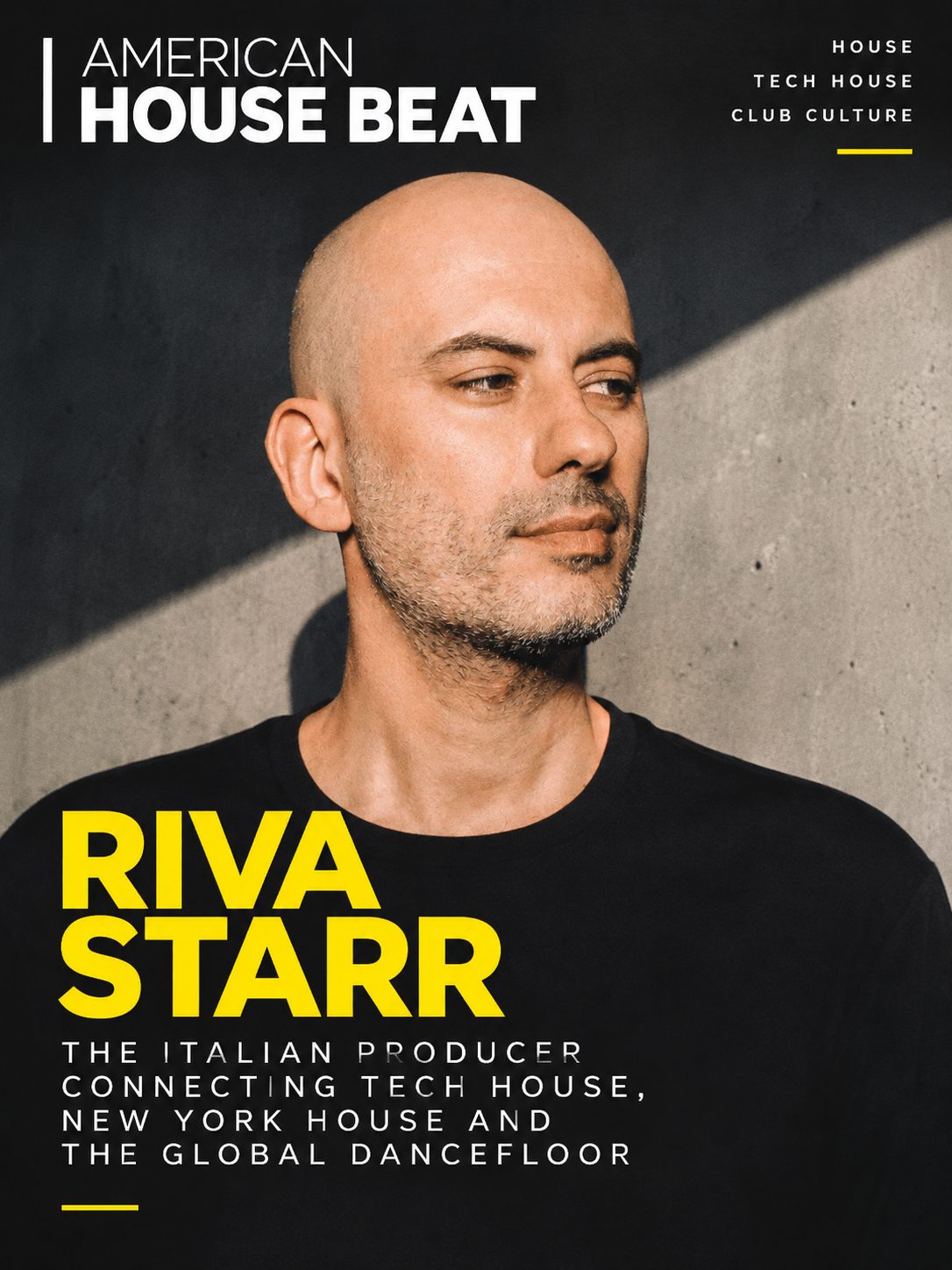
Italian DJ and producer Riva Starr has built a career by refusing to remain inside one genre.
Born Stefano Miele and now based in East London, he has moved through Tech House, House, Disco, Chicago influences, vocal music and more experimental club territory while maintaining one constant objective: making records that work on a dancefloor.
That flexibility has taken him from underground labels to some of the world's largest festivals and into collaborations with artists whose backgrounds extend far beyond electronic music.
His latest chapter arrived only weeks ago.
On October 16, 2026, Riva Starr joined Adam Port and JRM for the new single “Whole Room Dancing”, released on VOD.
The title could almost serve as a summary of his career.
Stefano Miele becomes Riva Starr
Riva Starr's real name is Stefano Miele.
Although Italian, his career became strongly connected to London, where he established himself inside a musical environment that encouraged crossing between different club traditions.
His official Snatch! biography describes him as a DJ, producer and label owner whose career has been shaped by rejecting rigid genre expectations.
That philosophy is fundamental.
Riva Starr is often placed inside Tech House.
But Tech House alone does not explain his catalogue.
Some records are raw and percussive.
Others are vocal.
Others borrow from Disco.
Chicago House.
African rhythms.
UK club music.
He treats genres as materials rather than boundaries.
The club comes first
There is, however, one filter.
Would the record work in the club?
This philosophy became part of the identity of Snatch! Records, the label Riva Starr founded in 2010.
Snatch! describes its original objective as supporting both emerging talent and established forward-thinking producers through strongly curated House music. Starr's own explanation is equally straightforward: artist hype matters less than musical quality and whether he can actually play the record in a club.
That approach helped Snatch! become an extension of his DJ identity.
The label does not simply release music.
It documents what Starr believes a dancefloor should sound like.
Snatch! builds its own ecosystem
Over time, Snatch! expanded beyond one label.
The project developed a sister imprint, Snatch! OFF, along with management activity connected to producers including Pirupa, Santos, Paul C & Paolo Martini, Paride Saraceni, Ruben Mandolini and others.
This placed Riva Starr in a role larger than producer.
Curator.
Label owner.
Talent developer.
DJ.
The combination resembles the traditional House model in which artists build infrastructure around themselves rather than relying exclusively on larger companies.
That model has deep roots in American House.
Chicago and New York scenes were built partly through DJs creating labels, parties and distribution networks around their own musical communities.
Riva Starr has adapted that philosophy to a modern European context.
Chicago remains part of the story
One of Starr's most significant periods came through his relationship with Cajual Records, the Chicago label associated with Cajmere, also known as Green Velvet.
His The Loft EP became a major Beatport and Traxsource success and received extended BBC Radio 1 support.
The connection makes sense.
Riva Starr's productions frequently share characteristics with Chicago House.
Direct drums.
Playfulness.
Vocals.
Tracks designed to create immediate physical reactions.
That influence distinguishes his version of Tech House from cleaner or more minimal European interpretations.
Collaborations beyond Tech House
Riva Starr's musical curiosity is visible in the artists he has worked with.
His official biography references collaborations or projects involving Horace Andy, Fatboy Slim and Arthur Baker, as well as remix work for artists including Wiley and London Grammar.
Those names come from completely different worlds.
Dub.
Big Beat.
New York dance culture.
Grime.
Indie electronic music.
For Starr, the differences become opportunities.
House music acts as the connecting mechanism.
From underground clubs to enormous stages
That versatility also explains his touring history.
Riva Starr has appeared at stages ranging from underground clubs to Glastonbury, Fuji Rock and Tomorrowland, while Snatch! itself has hosted festival programming at events such as Creamfields.
Moving between those environments requires a particular type of adaptability.
A small club demands patience.
A festival demands clarity.
A House record that can function in both spaces needs enough character to survive scale without losing groove.
Starr has spent much of his career operating exactly in that territory.
2026 shows the range
His current release schedule demonstrates that the genre-crossing approach has not disappeared.
On July 23, Riva Starr collaborated with salute on “soul reply” and also released his own warehouse-oriented version of the track through Atlantic Records UK.
On September 11, he appeared on the Footprints LP from PIV and released “Push Your Luck” with Andre Espeut and Close Counters through Heist Recordings.
Then came October's “Whole Room Dancing” with Adam Port and JRM.
Three different label environments.
Different collaborators.
Different areas of House.
One producer.
“Whole Room Dancing”
The latest single is particularly interesting because it connects Starr with Adam Port, a central member of Keinemusik and one of the artists associated with the current global expansion of more melodic and Afro-influenced House.
Released on October 16 through VOD, “Whole Room Dancing” runs at 123 BPM.
The collaboration places Riva Starr directly inside another contemporary House conversation.
But rather than representing a dramatic stylistic reinvention, it makes sense within his career.
He has always moved between scenes.
Tech House without a formula
The phrase “Tech House” can describe an enormous range of music in 2026.
At its most commercial, the genre is built around predictable drops, vocal hooks and highly standardised arrangements.
Riva Starr has generally been more difficult to reduce to that formula.
His music can contain Tech House mechanics without abandoning House history.
Percussion remains important.
Vocals carry personality.
Sampling becomes part of the storytelling.
The records often contain humour or unexpected details.
That makes his productions recognisable even when the genre changes.
An Italian artist with an international identity
Riva Starr also represents a particular type of Italian electronic career.
He is unmistakably Italian in origin, but his professional identity cannot be confined geographically.
London became home.
Chicago influenced the music.
Ibiza became part of the touring circuit.
Global festivals expanded the audience.
His records appeared on labels connected to different countries and traditions.
The result is less “Italian Tech House” than an Italian artist operating fluently inside global House culture.
Why America matters to the story
For American House Beat, Riva Starr is particularly interesting because so much of his work intersects with the foundations of US House.
Chicago.
New York.
Disco.
Vocal House.
Arthur Baker.
Green Velvet.
Cajual.
These connections are not cosmetic.
They show how House continually moves between the United States and Europe.
American music influenced European artists.
European producers reinterpreted it.
Those records then returned to American clubs.
The conversation never stopped.
Riva Starr belongs inside that cycle.
More than a producer
After more than a decade running Snatch!, Starr's influence cannot be measured only through his own discography.
The label created opportunities for other artists and established a network around a specific concept of club music.
That role matters increasingly in electronic culture.
A producer can make records.
A curator can help shape a scene.
Riva Starr has spent much of his career doing both.
The whole room still matters
The title of his latest release is unusually appropriate.
Whole Room Dancing.
That idea sits underneath almost everything Riva Starr does.
Not one viral moment.
Not one drop designed for a phone camera.
The room.
The collective reaction.
The physical function of House music.
His style has changed.
Labels have changed.
Collaborators have changed.
But after years moving between Tech House, Chicago grooves, vocal House, Disco and underground club music, the objective remains remarkably straightforward.
Make the whole room dance.