
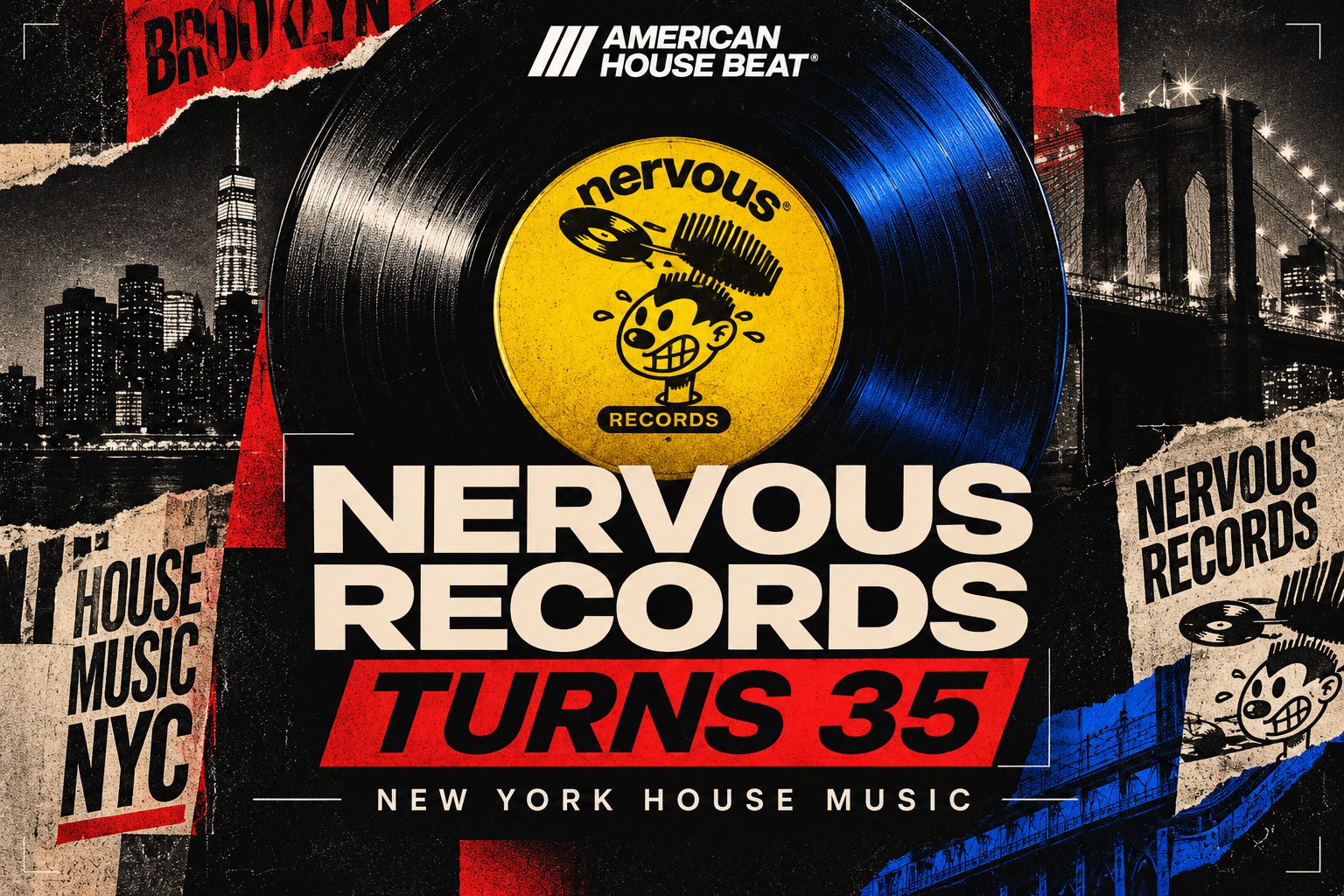
In electronic music, thirty-five years is almost an eternity.
Labels appear.
Genres change.
Formats disappear.
Dancefloors move.
Companies are sold.
Catalogues are absorbed.
And yet Nervous Records is still operating independently from New York in 2026, thirty-five years after launching in 1991.
The label is currently celebrating that milestone through new releases and events across New York, including a recent 35th-anniversary party in Brooklyn and forthcoming November dates with artists such as Louie Vega and Chus & Ceballos.
For American House Beat, Nervous represents something increasingly rare.
A direct bridge between early-1990s New York House and the contemporary club market.
East Coast House in 1991
When Nervous launched, New York House was entering an extraordinary period.
Labels such as Strictly Rhythm, Nu Groove, Emotive and Maxi were pressing records at a remarkable pace.
Producers including Kenny Dope, Louie Vega and Todd Terry were developing a distinctly New York interpretation of House built around Disco samples, raw drums, Soul and street-level club culture.
Nervous emerged directly inside that environment.
Not from outside the scene.
Inside it.
Michael Weiss and the family connection
The label was founded by Michael Weiss, working with his father Sam Weiss, founder of the earlier SAM Records.
Michael Weiss later explained that he wanted to create his own identity rather than simply continue his father's label legacy.
That decision produced one of the most recognisable brands in American dance music.
The name Nervous.
The cartoon DJ logo.
And a catalogue that would eventually extend across thousands of releases.
The logo becomes part of New York culture
Nervous became recognisable almost immediately because of its logo: the anxious cartoon character with a vinyl record passing through his head.
The image became much more than label identification.
It appeared on clothing.
Flyers.
Records.
Merchandise.
And eventually became an icon of New York dance culture itself.
The label says its merchandise developed audiences not only in the United States but also in Japan and across Europe during the 1990s.
That is an important part of the story.
Nervous was not only selling records.
It was building visual identity around club culture long before modern electronic brands turned merchandise into a central business.
“Feel Like Singing”
One of Nervous' first major dance successes arrived in 1992 with Sandy B's “Feel Like Singing.”
That record helped establish the label's early House identity.
Soulful vocals.
New York drums.
Music designed for clubs but emotionally direct.
It captured something fundamental about East Coast House.
Underground did not have to mean cold.
A track could be raw and still feel joyful.
Masters At Work and Nuyorican Soul
The label's catalogue also intersects with some of the most important names in American House.
Resident Advisor's current biography for Michael Weiss highlights the debut release from Masters At Work as Nuyorican Soul, alongside early material connected to artists including Armand Van Helden, Kerri Chandler, Byron Stingily, Todd Terry, Roger Sanchez, Mood II Swing, Felix Da Housecat and DJ Pierre.
That list reads like a compressed history of American House.
Nervous did not simply observe that history.
It participated in creating it.
More than House
Perhaps the most surprising part of the Nervous story is how quickly it moved outside House.
The label became involved in Hip-Hop through artists including Black Moon and Smif-N-Wessun, releasing albums that later became landmarks of East Coast rap.
It also moved into Reggae through Mad Lion and other associated projects.
That flexibility mattered.
New York club culture was never divided as cleanly as genre histories sometimes suggest.
House DJs listened to Hip-Hop.
Hip-Hop producers sampled Disco.
Reggae interacted with both.
Nervous reflected the city rather than one isolated genre.
Josh Wink and “Don't Laugh”
In 1994, Nervous signed Josh Wink, then releasing as Winx.
The follow-up record “Don't Laugh” became a major electronic success and expanded the label's relationship with Techno and Acid.
Again, genre borders moved.
House label.
Techno record.
American club hit.
The dancefloor determined what belonged.
Byron Stingily and Garage House
In 1996, Nervous released the debut solo album by Byron Stingily, former singer of Ten City.
The label describes the project as helping trigger a Garage House revival.
This period reinforced another Nervous characteristic.
Vocals mattered.
In a culture increasingly focused on production technique, Nervous continually maintained links with the song-based side of House.
That tradition still remains central to New York.
Surviving the collapse of the original label ecosystem
The early-1990s New York label landscape was crowded.
Many of the companies that defined that period eventually closed or had their catalogues absorbed by larger corporations.
Nervous survived.
DJ Mag described it at its 30th anniversary as one of the last major labels from that original ecosystem still operating independently.
That survival is remarkable.
Vinyl collapsed.
Digital downloads arrived.
Beatport arrived.
Streaming arrived.
Social media changed promotion.
The sound of House itself went through several commercial cycles.
Nervous adapted to all of them.
More than 5,000 releases
By its 30th anniversary, the label estimated that it had already released more than 5,000 records.
That number says something about the way Nervous operates.
It is not a boutique label releasing three carefully protected records per year.
It behaves more like a continuous music pipeline.
House culture moves quickly.
DJs constantly need new records.
Nervous kept feeding that system.
The contemporary catalogue
The most impressive part is that Nervous is not functioning purely as a heritage label.
Its current site features recent releases from artists including CASSIMM, Ralphi Rosario, Louie Vega, Luca Saporito & Andy Bros and others.
Recent years have also connected the catalogue with a newer generation of global House and Tech House artists.
Michael Weiss' current biography highlights releases including Loofy – “Last Night,” Mau P – “The Less I Know The Better” and Mochakk – “Da Fonk.”
That is a major point.
A label born in 1991 remains relevant to producers whose audiences were not even alive during its first decade.
History without becoming a museum
This is one of Nervous' greatest strengths.
It celebrates its history.
But it does not exclusively release archival reissues.
The label still wants new club records.
That distinction separates a living institution from a heritage brand.
The old catalogue provides credibility.
The new catalogue provides relevance.
Both are necessary.
Thirty-five years celebrated in Brooklyn
On November 7, 2026, Nervous celebrated its 35th anniversary at Brooklyn Pacha, continuing the label's relationship with New York nightlife.
The location is appropriate.
Nervous began in New York.
Three and a half decades later, the celebration remains tied to the city.
The label became global.
The identity stayed local.
Louie Vega keeps the story moving
The anniversary period continues with Louie Vega's annual Flashback party at Superior Ingredients in Brooklyn on November 25.
Vega will play an extended set built around House classics, Disco, Boogie and Masters At Work material.
This event almost perfectly summarises the Nervous philosophy.
New York history.
Contemporary club space.
Old records played for a current audience.
The past remains useful because people still dance to it.
Chus & Ceballos close the month
Nervous' November programme also includes Chus & Ceballos at Superior Ingredients on November 29.
This demonstrates the breadth of the current label ecosystem.
Latin-influenced House.
Tribal grooves.
Deep House.
Classic New York records.
Modern Tech House.
Different branches of the genre remain connected under the same wider platform.
New York House as infrastructure
The history of Nervous is ultimately not only about music.
It is about infrastructure.
Artists need labels.
Labels need clubs.
Clubs need DJs.
DJs need records.
Audiences connect everything.
Nervous survived because it remained involved in more than one part of that system.
Releases.
Events.
Merchandise.
Artists.
Catalogue.
Brand.
Community.
Why 35 years matters
Electronic music frequently celebrates novelty.
The newest DJ.
The newest subgenre.
The newest venue.
Longevity can be less fashionable.
But thirty-five years of independent operation means something.
Nervous Records survived the exact industry that consumed many of its contemporaries.
It adapted without erasing its identity.
The logo is still there.
The New York connection is still there.
House remains at the centre.
The technology surrounding it has changed completely.
Still nervous
The best anniversary story would be one where the institution feels slightly unstable.
Still curious.
Still willing to sign something unexpected.
Still willing to release too many records.
Still willing to put House music first.
That has been Nervous' strategy since 1991.
Thirty-five years later, the label is not simply part of New York House history.
It is still producing that history in real time.
NERVOUS RECORDS — 35 YEARS
Founded: 1991
New York City
Upcoming November events include Louie Vega's Flashback at Superior Ingredients on November 25 and Chus & Ceballos on November 29.