
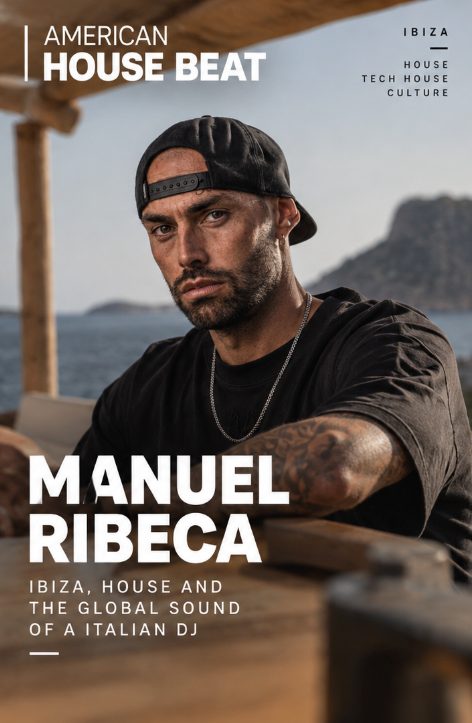
Italian DJ and producer Manuel Ribeca has built his career at the intersection of House, Tech House, Ibiza nightlife and international club culture.
Starting from central Italy, he has gradually developed a profile that now connects Italian clubs with Ibiza, Amsterdam, Miami, Asia and the wider European circuit.
His story is not built around one viral breakthrough.
It is built through years of touring, production and adaptation.
From Terni to the booth
Ribeca comes from Terni, in Umbria.
His interest in electronic music developed through club culture rather than through formal music education.
In an interview with Shaman Records, he explained that his passion began when he was around 17 and regularly attended Red Zone Club in Perugia, one of the key venues in central Italy’s House and electronic scene during that period.
Listening week after week to international DJs gave him an education in how a dancefloor works.
That experience eventually pushed him toward DJing himself.
Sirup Music dates his beginnings as a DJ to 2005.
Italian House roots
The artists Ribeca cites as formative tell a lot about his musical DNA.
Ricky Montanari.
Flavio Vecchi.
Massimino Lippoli.
Ricky L.
Sauro Cosimetti.
These names belong to a specifically Italian interpretation of House music — groove-driven, club-focused and often deeply connected to resident culture.
That history separates Ribeca from a newer generation of producers who entered electronic music primarily through digital platforms.
His foundations came from rooms.
Not feeds.
Ibiza as a career engine
Ibiza became one of the most important territories in Ribeca’s career.
Coverage from 2017 already documented an intense summer programme including Bora Bora, Eden, Privilege and Hotel Pacha, along with other appearances across the island.
That relationship continued.
By 2026, When We Dip described him as an Ibiza staple, highlighting performances at Hï Ibiza and Amnesia Ibiza.
This is significant because Ibiza remains one of the hardest markets in electronic music to sustain over time.
The island constantly changes.
Venues change.
Promoters change.
Sounds change.
A DJ who continues returning has to adapt without losing identity.
House, Minimal and Tech House
Ribeca’s sound sits mainly between House, Tech House and Minimal, with occasional movement toward Melodic House.
Sirup Music describes his approach as an underground but groovy combination of those styles.
His music is generally built around rhythm rather than spectacle.
Strong kick drums.
Percussive detail.
Rolling basslines.
Short vocal elements.
Repeated grooves that work over long club sets.
“Traigo Mi Flow,” released on Motel Calypso in February 2026, reflects that language particularly clearly.
The track combines hypnotic percussion, warm bass and processed vocals with a direct Tech House framework.
A strong 2026 release schedule
Ribeca’s 2026 catalogue shows a producer working consistently rather than sporadically.
Beatport lists releases including “Money Is Blue,” “Bring Me Joy,” “My House EP,” “Unano” and appearances on various compilations including Amsterdam 2026.
His label history includes Sola Records, Clarisse, And Dance, Motel Calypso, NONSTOP, Techaway, La Pera and Sonoros/Sirup Music.
That diversity suggests an artist comfortable moving between different parts of the House ecosystem rather than tying his identity to one label.
International support
Ribeca’s productions have received support from names including Jamie Jones, Cloonee and Ilario Alicante.
Those three artists occupy different but overlapping areas of the contemporary club market.
Jamie Jones brings the global House and Ibiza connection.
Cloonee represents a newer Tech House generation.
Ilario Alicante links the project with Italian and European Techno culture.
The range of that support reflects Ribeca’s ability to sit between scenes.
Miami and the international circuit
His career began expanding internationally around 2012 after appearances connected to Miami’s WMC period.
From there, older coverage documents dates across Romania, Slovakia, Hungary, Israel and Switzerland, alongside Italian clubs such as Twiga, Samsara, Miu, Villa delle Rose and Duel Beat.
That network gradually widened.
By 2026, Ribeca was also touring in Asia, including stops in Thailand and Bali.
For an Italian DJ, this trajectory is notable.
The career is not dependent on one domestic circuit.
It moves.
Amsterdam Dance Event
Amsterdam is another recurring part of his international presence.
When We Dip highlights multiple performances at Amsterdam Dance Event, placing Ribeca inside one of the world’s most important electronic music meeting points.
ADE is particularly important for artists operating in House and Tech House because it functions simultaneously as festival, conference and global industry meeting.
Playing there creates visibility beyond one crowd.
Agents.
Labels.
Promoters.
Other artists.
The network expands around the performance.
From DJ to producer
One of the most important developments in Ribeca’s career has been the shift toward production as a central activity.
Older profiles already described him as a DJ known for bootlegs, mashups and improvisational energy in the booth.
Over time, original production became much more important.
A 2021 profile noted several Beatport Top 100 entries across Tech House and Melodic House & Techno releases.
By 2026, the release schedule had become significantly denser.
That evolution matters because it changes how an artist travels internationally.
A DJ can be booked because of performance.
A producer can travel through records even before entering the room.
Collaboration and club energy
Recent collaboration with Sohail on Clarisse Records shows Ribeca pushing further into highly physical Tech House.
Beatportal described the three-track project through samba-influenced percussion, heavy basslines and vocal-driven club energy.
The tracks are direct.
Festival-ready.
But still rooted in groove.
That combination mirrors much of Ribeca’s career.
Accessible enough for large rooms.
Underground enough to remain connected to club culture.
A career between generations
Manuel Ribeca belongs to an interesting generation of Italian DJs.
He began before Instagram and TikTok defined visibility.
He came through resident culture and physical clubs.
Then he adapted to Beatport, international touring, streaming and the modern producer economy.
That background gives his career continuity.
He understands both sides.
The older culture of long club nights.
And the current world of international releases and touring.
Italian roots, international language
Ultimately, Ribeca’s identity remains Italian without being geographically limited.
Umbria provided the foundation.
Ibiza became one of the engines.
Amsterdam and Miami expanded the network.
Asia added another chapter.
Labels and production strengthened the international profile.
The musical language connecting everything is House.
Sometimes deeper.
Sometimes minimal.
Sometimes more melodic.
Often Tech House.
But always built around groove.
That may be the clearest way to understand Manuel Ribeca.
Not as an artist tied to one specific genre label.
But as an Italian DJ and producer who has spent more than twenty years translating club culture from one dancefloor to another.