
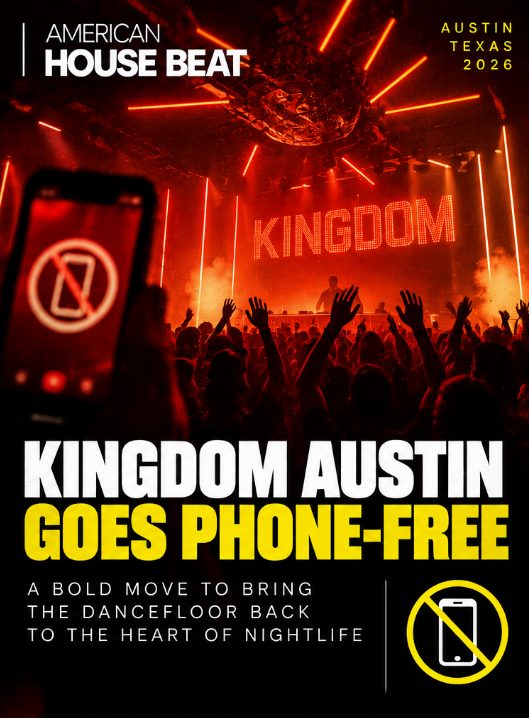
Austin’s electronic nightlife is experimenting with a simple rule that could dramatically change the dancefloor.
Kingdom Nightclub has introduced a phone-free policy requiring guests to keep their devices put away while dancing, with phone cameras covered when patrons enter the venue.
The policy was announced on October 19 and officially took effect on October 23, 2026. (ouraustin.org)
For a club built around house, techno and electronic music, the decision goes directly to the heart of a larger debate in contemporary nightlife.
Are people still dancing for the room?
Or are they increasingly dancing for the camera?
The camera disappears from the dancefloor
Kingdom is not asking guests to leave their phones at home.
The devices can remain with them.
The difference is that cameras are covered and the club asks guests to keep phones tucked away while on the dancefloor. (mysanantonio.com)
That may sound like a small intervention.
Inside a nightclub, it changes almost everything.
No constant filming.
No raised screens blocking the view.
No flash.
No immediate pressure to document the track currently playing.
No audience turning toward the DJ every time a recognisable drop arrives.
The dancefloor becomes less visible online.
But potentially more intense inside the room.
A return to 1990s club culture
Kingdom owner Garrett Boyd has connected the decision to the club culture of the 1990s, when audiences entered electronic venues without carrying a recording device in their pockets.
The goal is to encourage people to focus on music, movement and the people around them instead of constantly producing content from the night. (kkam.com)
The idea carries a certain irony.
Dance music spent decades trying to become visible.
Underground clubs developed outside mainstream media.
DJs relied on flyers, radio and word of mouth.
Then social media transformed nightlife into a constant stream of images and video.
Now some venues are deliberately trying to become less visible again.
Kingdom and the history of Austin dance music
Kingdom has its own history inside Austin electronic culture.
The original club opened in 2011 and developed a following around house, techno and electronic bookings before closing in 2018.
The project returned in 2022 at 505 East 7th Street, inside Austin’s Red River Cultural District. (atxconcertlog.com)
The current venue operates Wednesday through Saturday, with later closing hours on Friday and Saturday depending on the programme. (kingdomnightclub.com)
Its programming regularly moves through house, techno and wider dance music.
Upcoming bookings include Dennis Ferrer, Jody Wisternoff and Nic Fanciulli, reinforcing its place within Austin’s club-focused electronic circuit. (texasedm.net)
That makes the phone policy particularly interesting.
This is not a concert hall imposing restrictions for one special performance.
It is a nightclub making the rule part of its everyday culture.
Why phones changed club behaviour
Phones did more than add cameras to nightlife.
They changed behaviour.
A DJ once interacted primarily with the crowd directly in front of the booth.
Now part of that crowd may be watching the same moment through a screen.
The most dramatic sections of sets are often recorded immediately.
Tracks can circulate online within minutes.
Unknown IDs become social content.
For artists, this can create enormous exposure.
For venues, it becomes marketing.
But something is lost at the same time.
People become aware that they may be recorded constantly.
Dancing becomes performative.
A private moment becomes permanent.
For younger clubbers in particular, the possibility of appearing in someone else’s video can change how freely people move.
That tension is part of what Kingdom is responding to.
Austin is not alone
Kingdom is part of a wider trend.
Other Austin venues and events have experimented with restricted phone use, while phone-free policies are already familiar in comedy and at selected concerts. (mysanantonio.com)
But nightlife creates a different situation.
A concert has a clear performer and audience.
A club is more collective.
The crowd is part of the event.
That makes privacy particularly important.
People dance differently when they do not expect to appear online the following morning.
There are critics too
The reaction has not been universally positive.
Some patrons argue that filming a short clip is part of how they remember a night or share music with friends.
Others have questioned how the policy will be enforced and whether phones can still be accessed when necessary. (yahoo.com)
Those concerns are legitimate.
Phone-free nightlife only works if the policy remains practical.
People still need communication.
Transport apps.
Emergency access.
The challenge is creating a dancefloor culture without turning the restriction itself into another source of friction.
Less content, more presence
For American house and techno, Kingdom’s experiment touches something fundamental.
The culture was built around presence.
A DJ played music that might never be heard again in exactly the same sequence.
A crowd existed together for a few hours.
Then the night disappeared.
Social media changed that.
Now almost every event leaves behind hundreds of fragments.
Videos.
Stories.
Photos.
Track IDs.
Kingdom is asking whether some nights should be allowed to disappear again.
A test for American club culture
The new policy is still young.
It is too early to know whether patrons will embrace it permanently.
But Kingdom has already made the dancefloor itself part of the conversation.
That may be more important than the stickers covering the cameras.
House and techno do not require phones.
They require sound.
A room.
A DJ.
And people willing to remain present long enough for something to happen.
At Kingdom, Austin is testing whether removing one piece of technology can bring the rest of those elements closer together.
For a culture increasingly documented in real time, that feels almost radical.
KINGDOM NIGHTCLUB
505 E. 7th Street
Austin, Texas
Phone-free dancefloor policy in effect since October 23, 2026. (kingdomnightclub.com)