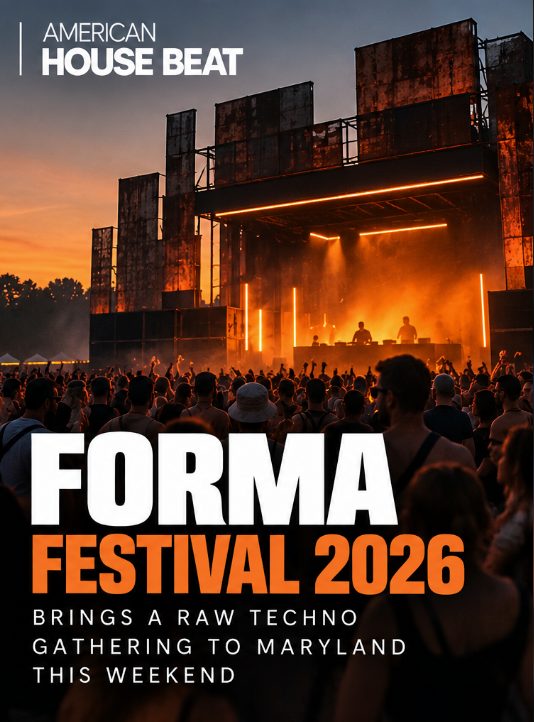
Maryland is preparing for a different kind of electronic festival.
On October 17, FORMA Festival 2026 will bring a techno-focused gathering to Boyds, Maryland, with a lineup built around driving, underground and distinctly club-oriented sounds.
Resident Advisor has selected the event as an RA Pick, describing FORMA as a gathering for “the techno faithful” and highlighting performances from Dustin Zahn, Lady Starlight and a wider group of artists operating across the American underground.
The lineup includes Dustin Zahn, Lady Starlight, Luke Hess, Lindsey Herbert, Jay York, Marteka Fair, Adrian Hex, TonalTheory, N3urodegenerate and several other artists.
For the American electronic landscape, that programming immediately makes FORMA stand apart from the dominant festival model.
There are no major EDM crossover headliners.
No pop collaborations driving the top of the bill.
No attempt to blend dozens of genres purely for scale.
The focus is techno.
A festival built around the underground
This distinction is increasingly important in the United States.
The American festival market remains one of the largest in the world, with enormous events capable of attracting audiences across EDM, house, techno, bass and commercial dance music.
But alongside that ecosystem, a smaller network of festivals continues to develop around more specific communities.
FORMA belongs to that second model.
Its programming reflects artists with deep connections to club culture rather than the conventional mainstage circuit.
Dustin Zahn has spent decades working within American and international techno. Detroit artist Luke Hess brings a different strand of the genre, rooted in the city’s long relationship with futuristic electronic music. Lady Starlight represents another intersection between performance and underground techno culture.
Together, those names give the event a clear identity before the first record is played.
Techno outside the usual American capitals
The location is equally interesting.
When American techno is discussed internationally, attention usually moves toward Detroit, New York, Chicago or Los Angeles.
Maryland rarely occupies the same position in that conversation.
That is exactly what makes events such as FORMA worth watching.
Scenes grow when programming moves beyond the cities already recognised as cultural centres.
A strong festival can create temporary connections between local audiences, touring DJs, promoters and regional artists who might otherwise operate in separate circuits.
In that sense, FORMA becomes more than a lineup.
It becomes infrastructure.
For one weekend, a location outside the most obvious US electronic capitals becomes part of the national techno network.
A different definition of scale
Large American festivals often define success through size.
Bigger stages.
Bigger production.
Bigger headliners.
FORMA appears to work with a different definition.
The strength of the event lies in concentration rather than expansion.
One musical direction.
A lineup that makes sense as a whole.
An audience likely to arrive specifically for techno rather than discovering it as one option among ten festival stages.
That kind of focus can create a different atmosphere.
The relationship between artists becomes more important because each set contributes to the same musical narrative.
The crowd also arrives with a more specific expectation.
This is not necessarily the model that will dominate the American festival market.
It does not need to.
Its value comes from offering an alternative.
American techno keeps decentralising
FORMA also reflects a broader reality.
American techno is increasingly difficult to describe through only a handful of cities.
Artists travel constantly between regional scenes. Independent promoters are developing events outside major nightlife centres. Smaller festivals are connecting audiences who may not have permanent techno institutions close to home.
That decentralisation can ultimately strengthen the wider ecosystem.
Detroit will always remain fundamental to techno history.
New York, Chicago and Los Angeles continue to play major roles.
But the future of the genre in the United States will also depend on what happens outside those places.
On October 17, FORMA Festival brings that idea to Maryland.
Not as a giant commercial spectacle, but as a focused gathering built around the sound itself.
And in the current American festival landscape, that may be exactly what makes it worth paying attention to.